
QuébecPolitique.com
- Partis politiques:
Political Parties
FR EN ESIntroduction
As it happens in most Western democracies working under an electoral system such as the "first past the post" system, Quebec's system of political parties is made of a few (two or three, depending on the era) "catch-all parties", slightly polarized and gaining almost all the votes in an election. In such context, Quebec worked under a two-party system for most of the XIXth and the XXth Century, leaving almost no room at all to small parties.
Political Parties and the Election Act
The legislative framework of the system of political parties in Quebec lies in the Loi électorale (Election Act). Among others, the Election Act states that people seeking to form a political party must be accreditated to the Directeur général des élections (Chief Electoral Officer) by the means of an "authorization" allowing the parties to solicit or receive political contributions, contract loans or pay expenses, especially diring electoral campaigns. As we shall see later, this process is not intended to control or evaluate party programs and policies, but to ensure that parties work under the general principles of democracy and respect the provisions of the Election Act about political contributions and election expenses.
People who seek to form an authorized political party must fill out an application for authorization of a political party. This application must beaccompanied by a 500$ deposit and the signatures and addresses of at least 25 electors by constituency, in at least 20 constituencies (which means that is must include at least 500 electors). By doing so, the signatories admit that they are members or sympathizers of the party and are in favor of the authorization. Finally, within six months after the authorization, the party must send the Chief Electoral Officer a copy of its by-laws duly adopted by the members at a general meeting.
The authorization remains valid as long as the party pays its bills and its interest, files the information and the reports prescribed under the Election Act and presents a minimum of twenty candidates at each general election.
Political Cleavages
As it happened in most Western countries, the left-right cleavage, in other terms, the cleavage between the Progressives and the Conservatives, is the basis upon which a system of political parties was built in Quebec. However, due to the existence of "catch-all parties" similar to those present in Britain, Canada and the United States, the left-right cleavage is less salient in Quebec than in continental Europe, and the political parties of Quebec are far less polarised than, for example, in France or Germany.
On the other hand, due to the debate upon Quebec's independence of the past fourty years, a new cleavage piledupon the left-right cleavage: it's the cleavage between the advocates of Quebec's independence and the those who prefer that Quebec remain a canadian province (independence-federalism cleavage). Little by little, this cleavage imposed itself in the political agenda and, since 1981, the independence-federalism cleavage takes precedence to the left-right cleavage. This shift caused the disappearance of parties with an ambivalent or moderate platform on the issue of independence, such as the Union nationale or the Social Credit. Unlike the left-right cleavage, there is no room for a "centrist" or "in between" position between independence and federalism.
Table I: The Left-Right Cleavage
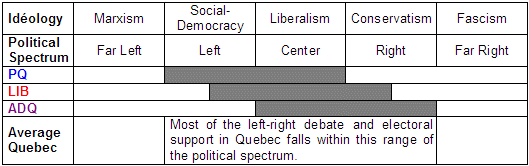
In this table, the political spectrum is divided into five ideological categories: Far Left (Marxism), Left (Social-démocracy), Centre (Liberalism), Right (Conservatism) and Far Right (Fascism). Both extremes (Far Left and Far Right) are openly antidemocratic and, thus, extremist (obviously !).
Table II: The Independence-Federalism Cleavage
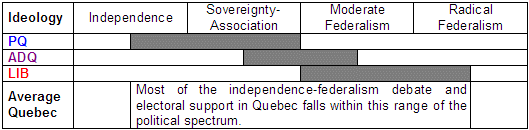
In this table, the constitutional options for Quebec are displayed in four categories. The Independentists are for Quebec's independence or sovereignty, no matter if there is an economic association between Canada and an independent Quebec or not. The advocates of sovereignty-association are also for Quebec's independence, but would prefer that an independent Quebec maintaint an economic association (e.g. custom union, monetary union) with the rest of Canada. On the other hand, the Moderate Federalists perfers that Quebec remains a member of the Canadian Federation. However, they recognise that Quebecers are a nation, and that the State of Quebec should have as many powers as possible to assume Quebec's destiny and developpement, essentially thorough decentralization and a constitutional recognition of the Quebecers as a nation. Finally, the Radical Federalists are favourable to the constitutional status quo and, sometimes, go as far as refusing to recognize the existence of the Quebec nation. They also advocate for intransigeance if Quebec becomes an independent state (thorough policies such as partition of Quebec's territory, refusal to recognize Quebec's independence, etc).
The Main Political Parties
During the general elections held on November 30, 1998, ten political parties presented candidates in 20 or more constituencies. However, all the parties do not have the same importance in the political scene.
Due to the electoral system and the polarization on the issue of independence, Quebec's system of political parties is basically made of "catch-all parties", which gain most of the electoral support. In such context, the three most important political parties of Quebec, those who succeded to elect MNAs in 1998, won 98,23% of the valid ballots during the last general election. The three main political parties in Quebec are the Parti québécois (Quebec's Party), le Parti libéral du Québec (Quebec Liberal Party) et l'Action démocratique du Québec (Quebec Democratic Action).
 The Parti libéral du Québec is the political party currently
holding the power in Quebec, winning the last general elections with 45,99% of the votes
and electing 76 MNAs. This party, hoping that Quebec remains a
canadian province, defends an ideology close to the liberal-conservative tendency, placing
this party, among the three main political parties, on the right side of the political
spectrum.
The Parti libéral du Québec is the political party currently
holding the power in Quebec, winning the last general elections with 45,99% of the votes
and electing 76 MNAs. This party, hoping that Quebec remains a
canadian province, defends an ideology close to the liberal-conservative tendency, placing
this party, among the three main political parties, on the right side of the political
spectrum.
 The Parti québécois is the Official
opposition in the National Assembly. It elected 45 MNAs in 2003 and gained 33,24% of the
valid ballots during the last general elections. Among the three main political parties, the P.Q. is the one who is
situated on the left of the political spectrum, advocating for a social-democratic
society. In addition, the Parti québécois is for Quebec's independence or, as it is
called in Quebec, sovereignty.
The Parti québécois is the Official
opposition in the National Assembly. It elected 45 MNAs in 2003 and gained 33,24% of the
valid ballots during the last general elections. Among the three main political parties, the P.Q. is the one who is
situated on the left of the political spectrum, advocating for a social-democratic
society. In addition, the Parti québécois is for Quebec's independence or, as it is
called in Quebec, sovereignty.
 Finally, the third most important political party in
Quebec, ans also the youngest, is the Action démocratique du Québec, which gained 18,18%
of the votes in 1998 and elected 4 Members of the National Assembly. Generally speaking, this party is situated sligntly on the right of the Parti
libéral du Québec on the political spectrum, even if it defends some policies that are
closer to the center of the political spectrum. In addition, the A.D.Q. advocates for the
decentralization of many powers from the Federal Government to the Quebec Government. It
also claims that if such decentralization was to be impossible to achieve, independence
would be desirable for Quebec.
Finally, the third most important political party in
Quebec, ans also the youngest, is the Action démocratique du Québec, which gained 18,18%
of the votes in 1998 and elected 4 Members of the National Assembly. Generally speaking, this party is situated sligntly on the right of the Parti
libéral du Québec on the political spectrum, even if it defends some policies that are
closer to the center of the political spectrum. In addition, the A.D.Q. advocates for the
decentralization of many powers from the Federal Government to the Quebec Government. It
also claims that if such decentralization was to be impossible to achieve, independence
would be desirable for Quebec.
The seven other authorized political parties worth, together, 2,59% of the valid ballots casted during the 2003 general election. They are, in alphabetical order, the Bloc pot, the Parti démocratie chrétienne du Québec (Christian Democracy Party of Quebec), the Parti égalité (Equality Party), the Parti marxiste-léniniste du Québec (Marxist-Leninist Party of Quebec), the Parti vert du Québec (Green Party of Quebec) and the Union des forces progressistes (Union of Progressive Forces).
Sources
Bernard, André. 1996. La vie politique au Québec et au Canada. Sainte-Foy : Presses de l'Université du Québec.
Directeur général des élections du Québec. 1999. Loi électorale. Règlements électoraux. L.R.Q., c. E-3,3. À jour le 15 novembre 1999. Sainte-Foy: Le Directeur.
Loriot, Gérard. 1998. La démocratie au Québec : origines, structures et dynamique. Mont-Royal : Décarie Éditeur.
Pageau, Gilles, et Jacques Laflamme. 1990. Le Système électoral québécois: Manuel des connaissances de base. Quatrième édition. Sainte-Foy: Le Directeur général des élections du Québec, 1999. Coll. Études électorales.
Perreault, Charlotte, et Madeleine Albert. 1996. Cinquante ans au coeur de la démocratie : le Directeur général des élections et l'évolution de la législation électorale de 1945 à 1995. Sainte-Foy: Le Directeur général des élections du Québec. Coll. Études électorales.
Thibault, Richard. 1993. Qu'est-ce que l'Assemblée nationale?. Édition mise à jour. Québec : Assemblée nationale du Québec, Direction générale de l'information, Direction des communications et de l'accueil.
Last update: 20 janvier 2005